
Whether the tone is clean or distorted, a lot of getting the bass to sit comes down to knowing which frequencies to keep and which to move out of the way.
That is what the chart below is for. Under it is the approach I reach for most, which starts at the recording stage rather than at the EQ.
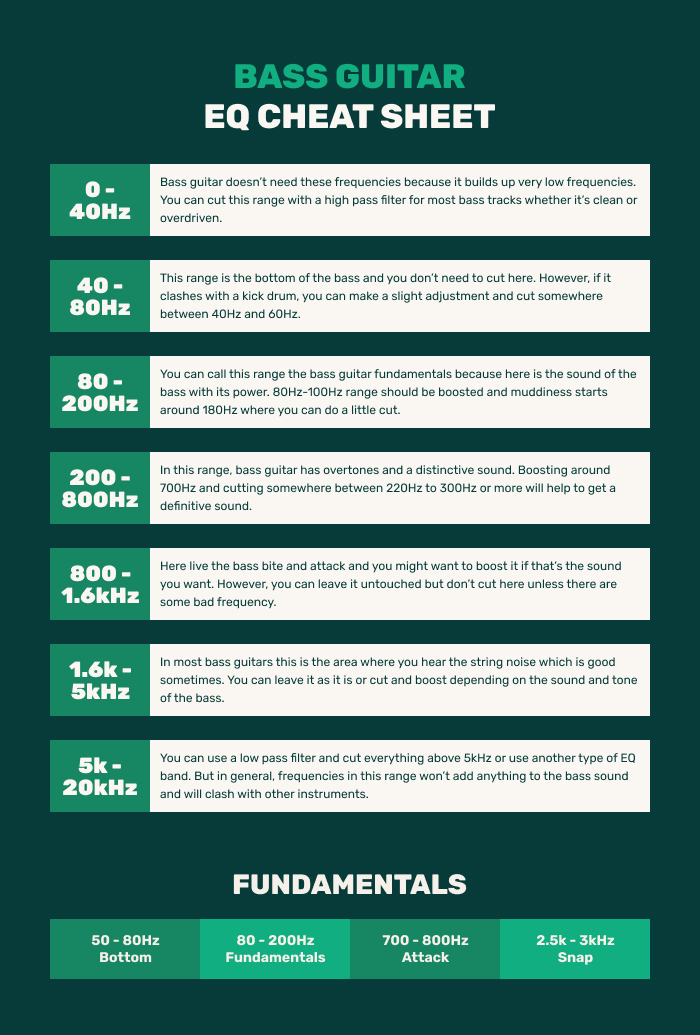
Bass Guitar Frequencies
I put this together for beginner and intermediate mixing engineers, though the ranges hold up whatever your level. What any given bass needs depends on the instrument, the player and what else is in the mix.
- 0-40 Hz – On a four-string, whose low E sits around 41 Hz, there is usually little down here but rumble, so a high-pass is often safe. Check the instrument first. A five-string’s low B is close to 31 Hz, so a filter at 40 Hz will thin the lowest notes on that string, and a down-tuned bass goes lower still.
- 40-80 Hz – The bottom of the bass, and usually best left alone. If it is fighting the kick, find where the two actually collide before you cut, rather than reaching for a fixed frequency.
- 80-200 Hz – Where the weight and power of the bass sits. A boost here can thicken a thin bass. If the low end sounds muddy instead of full, somewhere around 180 Hz is worth auditioning first.
- 200-800 Hz – Harmonics and character. On some basses, lifting around 700 Hz and easing back somewhere from 220 to 300 Hz makes the part more defined and easier to follow on small speakers. Audition both before you commit to either.
- 800 Hz-1.6 kHz – Bite and attack. Worth a boost if you want the bass to be heard rather than just felt. Leaving it flat is fine too, and cutting here is worth doing only when something specific is wrong.
- 1.6-5 kHz – String noise and finger or pick attack. Whether that is a feature or a problem is a taste call and a genre call, so push it or pull it to suit the track.
- 5-20 kHz – There is not much of the bass up here, and what there is can crowd the instruments that need the space, so a low-pass often helps. Listen before you reach for one on a bass with a lot of pick, slap or distortion in the tone, because that detail lives higher than people expect.
Free Download: EQ Frequency Chart Poster
Every instrument’s frequency range on one colour-coded chart. Print it, pin it above your monitors, and stop guessing where to cut.
How to EQ a Bass Guitar
There are plenty of ways to do this. The one below is my default, and it starts before the EQ does.
1. Record a DI and an Amp Track
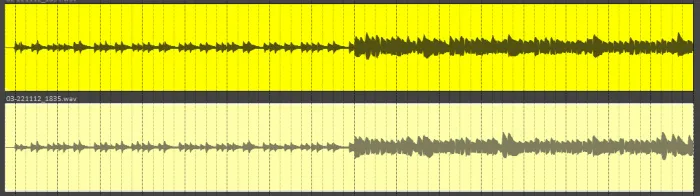
A bad recording is hard to EQ, so the tone comes first. Where bass differs from most instruments is that you can capture two versions of it at once: run a DI box alongside the amp and you get the clean signal and the amped signal from the same performance.
That gives you a DI track, the pure bass with no amp or effects, and an amp track, the same take with the tone on it. An amp sim instead of a real amp works the same way. You can absolutely EQ a single bass track and plenty of records are made that way, but two gives you a choice later that one does not.
2. Split the Range Between Them
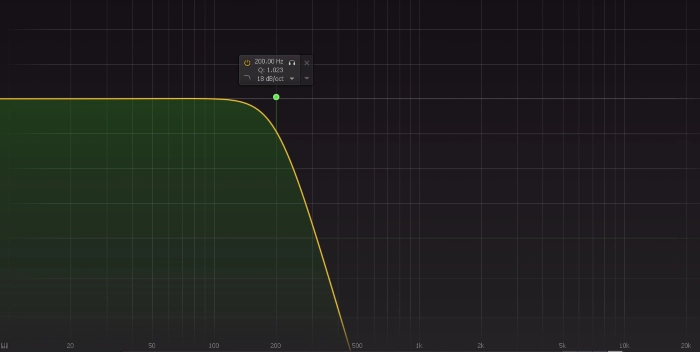
One way to use the two tracks is to let the DI carry the low end and the amp carry what sits above it. On the DI track, low-pass above roughly 200 Hz and high-pass the very bottom if the instrument does not need it, and what is left is a clean foundation with none of the amp’s noise in it.
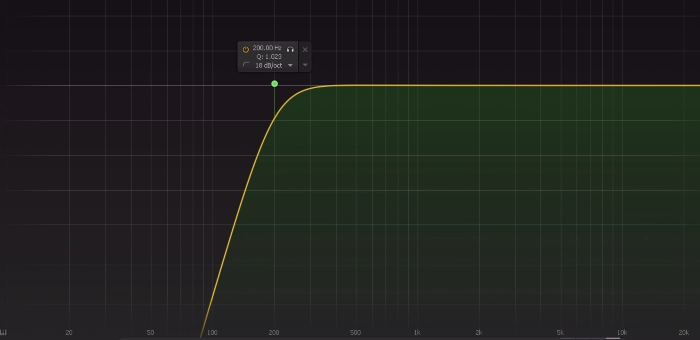
Then do the opposite on the amp track and high-pass it around the same point, since you already have your low end elsewhere. Treat 200 Hz as a starting point and move it by ear; where the two meet depends on the bass and the amp, and some amp tone below the crossover may be worth keeping.
Two things to check before you trust the result. Complementary filters are not phase-neutral around the crossover, so the two tracks can partly cancel where they meet even though each sounds right alone. And a DI and a miked amp do not arrive at the same time: the mic is metres of air away from the desk. Line them up, check the polarity, and listen to the low end with both tracks up and then with one muted. If the pair sounds thinner than the DI on its own, that is the problem.
3. EQ the Bass Bus
Send both tracks to a bass bus and treat that as the instrument from here on. Put an EQ on it and work normally: find what is not working and cut it, lift what the track needs more of.
Because you already separated the two halves, this stage is usually small, and a big move here often means something needs fixing further back at the split or the amp. The bus is also a natural place for compression, since by then it behaves as one instrument, though compressing the DI and amp separately is a legitimate choice too.
Tips for EQing Bass Guitars
- Get the tone before the EQ. Dial in a bass sound you actually like, and one that suits the song, before you open a plugin. EQ shapes a good tone; it does not invent one.
- Record the DI even when you do not plan to use it. It costs you an input and a little disk at tracking time, and it is far easier than trying to recreate the part later.
- Do not cut too much. If the tone is right and the range is split cleanly, what is left should be cosmetic.
- Check it against the kick. A lot of bass problems turn out to be kick problems. Listen to the two together, then in the full mix, before you decide anything in the bottom two octaves.
Conclusion
Use the chart to know where to look and the split to keep the low end clean. Neither is complicated, and both get faster the more basses you put through them. For the rest of the band, see our EQ cheat sheet by instrument.
Free Download: EQ Frequency Chart Poster
Every instrument’s frequency range on one colour-coded chart. Print it, pin it above your monitors, and stop guessing where to cut.

Lasha is a guitarist with over 18 years of experience who started out in local bands, then taught himself recording in 2010 and began tracking his own demos. He has written about music production since 2016, most recently at ApartmentRecording.com, covering recording and mixing techniques across guitar, bass and drums.