
An EQ cheat sheet tells you where each instrument tends to need attention, so you know where to start listening when you open a track you have never mixed before. This page pulls the most useful ranges from our instrument guides into one table, with a link to the full cheat sheet for each.
Every range here is a place to look, not a setting. The instrument, its tuning, the mic and the arrangement all change which frequencies matter, so make each decision in the full mix and compare it against the bypassed signal.
EQ Cheat Sheet by Instrument
The table gives the short version. Treat every cell as somewhere to sweep and listen before you move anything; the sections under it explain when a move is worth making.
| Instrument | Filter | Often cut | Often boost, if it needs it |
|---|---|---|---|
| Vocals | High-pass around 80Hz | Boom around 350Hz, boxy or nasal tone at 800Hz-1kHz; tame sharp S sounds at 5-10kHz with a de-esser | Presence at 3-5kHz, air at 10-16kHz |
| Bass guitar | Gentle high-pass around 30-40Hz on a standard four-string; a low-pass above 5kHz on clean tones | Mud around 180Hz, 220-300Hz for definition | Around 700Hz, bite at 800Hz-1.6kHz |
| Electric guitar | High-pass around 80-120Hz; low-pass around 7-8kHz on heavy tones | Boxiness at 400-500Hz, honk or harshness at 1-3kHz | Definition at 5-7kHz |
| Acoustic guitar | High-pass around 80Hz in a full mix | Boom at 150-250Hz, boxiness at 300-500Hz | Pick attack at 2-5kHz, sparkle at 5-10kHz |
| Kick drum | High-pass around 30-40Hz, or below the fundamental on an 808 | Boxiness at 300-500Hz | Body at 100-200Hz, beater at 2-5kHz |
| Snare drum | High-pass at 80-120Hz | Boxiness and ring, usually somewhere in 300-600Hz | Body at 150-250Hz, crack around 2kHz |
| Toms | High-pass below each tom’s fundamental, set per drum | Boxiness at 400-600Hz | Thump at 80-300Hz, stick attack at 3-7kHz |
| Cymbals | High-pass up to around 200Hz on spot mics, gently on overheads | Clang at 200-300Hz, piercing tone at 8-10kHz | Air with a gentle shelf at 12-15kHz |
| Piano (upright) | High-pass under 70Hz in a full mix | Boom at 100-200Hz, boxiness at 250-500Hz, honk at 1.5-2.5kHz | Presence at 2.5-5kHz, attack at 5-9kHz |
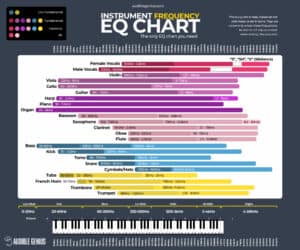
Free Download: EQ Frequency Chart Poster
Every instrument’s frequency range on one colour-coded chart. Print it, pin it above your monitors, and stop guessing where to cut.
Vocals
Start with a high-pass around 80Hz and move it by ear, because a deep voice can have fundamentals down there. Then listen for boom around 350Hz, a boxy or nasal spot between 800Hz and 1kHz, and sharp S sounds between 5 and 10kHz. Sibilance is intermittent, so control it with a de-esser rather than a static cut that dulls the whole vocal. Presence at 3-5kHz and air above 10kHz are the usual places to add. The vocal EQ cheat sheet has the full chart and a six-step process.
Bass Guitar
On a standard four-string the low E is around 41Hz, so a gentle high-pass just below it removes rumble without touching the notes. Check the instrument first: a five-string’s low B sits near 31Hz. Above that, 40-80Hz is usually best left alone unless it is fighting the kick. If the low end sounds muddy rather than full, audition a cut around 180Hz first. To make the part easier to follow on small speakers, try easing back somewhere from 220 to 300Hz and lifting around 700Hz. The bass EQ cheat sheet covers the full range and the DI-and-amp split.
Electric Guitar
Clean and distorted guitars share most of their problems: low end that fights the bass, boxiness around 400-500Hz and a honky spot between 1 and 3kHz. Distortion adds fizz up top, so heavy tones often get a low-pass around 7-8kHz, with a small lift at 5-7kHz for definition. The electric guitar EQ cheat sheet splits the ranges for clean and metal tones.
Acoustic Guitar
A directional mic placed close adds low end through proximity effect, which usually shows up as boom around 150-250Hz. A boxy take tends to have a build-up between 300 and 500Hz. The strum and the definition of each string come through at 2-5kHz, and 5-10kHz brightens a dull guitar. The acoustic guitar EQ cheat sheet goes range by range.
Drums
The kick’s weight is at 40-100Hz, the same region as the bass, so decide which of the two leads down there and give the other a little room. Listen for its body around 100-200Hz and the beater at 2-5kHz. On the snare, body shows up around 150-250Hz and crack around 2kHz, while boxiness and ring usually live somewhere between 300 and 600Hz. Toms need a high-pass set per drum, since a floor tom sits well below a rack tom, and cymbal spot mics can be filtered much harder than overheads. The drum EQ cheat sheet covers the whole kit and there is a separate guide to EQing a kick drum.
Piano
A piano spans most of the spectrum, so in a full arrangement it overlaps with almost everything. High-pass under 70Hz when it competes with a bass or kick, and leave more low end in a sparse arrangement. On an upright, listen for boom around 100-200Hz, boxiness at 250-500Hz and honk at 1.5-2.5kHz. For more clarity, presence is around 2.5-5kHz and attack around 5-9kHz, where a wide boost works better than a narrow one. Electric pianos behave differently, with their usual problem spot around 800Hz-1kHz, and the piano EQ guide gives separate starting points for each.
Moves That Apply to Every Instrument
- Filter with care. A high-pass clears rumble and makes room for the bass and kick, but set too high it takes the body of the instrument with it. Our guide to high-pass and low-pass filters covers how to set them.
- Narrow for problems, wide for tone. A narrow cut is the usual tool for a single resonance. Broad tonal changes tend to sound more natural with a wider band.
- Use a map. The audio frequency range chart covers the whole spectrum from sub-bass to air.
- Level-match before you judge. Most EQ moves change perceived loudness, and a louder signal tends to win a quick comparison. Match the EQ’d signal to the bypassed one before you decide a move helped.
Conclusion
A quick way to use this page: name the problem you hear, find its range in the table, sweep to confirm where it really is, make a small move, then level-match and check it with everything playing. Recheck after you change levels or compression, because both shift what the EQ is doing. Our guide to mixing a song shows where EQ fits in the whole process.
Free Download: EQ Frequency Chart Poster
Every instrument’s frequency range on one colour-coded chart. Print it, pin it above your monitors, and stop guessing where to cut.

Lasha is a guitarist with over 18 years of experience who started out in local bands, then taught himself recording in 2010 and began tracking his own demos. He has written about music production since 2016, most recently at ApartmentRecording.com, covering recording and mixing techniques across guitar, bass and drums.