
An acoustic guitar covers a wide range, from the thump of the body to the shimmer of the strings, and it shares most of that range with the vocal, the piano and everything else in the midrange.
This cheat sheet shows where to start listening. Every guitar, mic and room is different, so treat the ranges as places to check rather than settings to dial in.
Acoustic Guitar Frequencies
These are the ranges that come up on most acoustic tracks. For compression, effects and the full process, see our guide to mixing acoustic guitars.
- Below 80Hz – Mostly handling noise, stand thump and room rumble, plus low end that competes with the bass and kick. A high-pass around 80Hz is a common starting point in a full mix. On a solo guitar or in a sparse arrangement, set it lower: the low E string sits at about 82Hz, and drop tunings go lower still.
- 80-250Hz – Body and boom. This is the wood of the guitar, and a directional mic placed close adds more through proximity effect. Cutting a few dB around 150-250Hz clears up a boomy take. Cut too much and the guitar turns thin.
- 250-800Hz – Boxiness and mud. A cut somewhere in this range, often around 300-500Hz, helps a guitar that sounds like it was recorded in a cardboard box. Some guitars need nothing here.
- 800Hz-2kHz – Midrange tone. Lifting it slightly helps the guitar poke through a busy mix. A narrow cut helps if it sounds nasal or honky.
- 2-5kHz – Presence and pick attack, the part of the tone that carries the strum and the definition of each string. A small boost brings the guitar forward. This is also where it competes with the vocal, so decide which of the two owns the range.
- 5-10kHz – Sparkle and string detail. A gentle shelf or a wide boost can brighten a dull guitar. Listen for pick noise and finger squeak before you push it.
- 10-20kHz – Air. Leave it alone on a clean recording. If the guitar is fighting the cymbals or there is hiss up here, a gentle low-pass filter helps, but a steep one at 10kHz will take the life out of it.
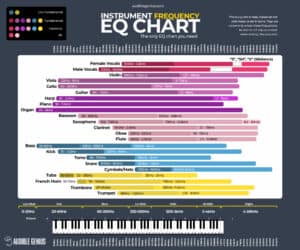
Free Download: EQ Frequency Chart Poster
Every instrument’s frequency range on one colour-coded chart. Print it, pin it above your monitors, and stop guessing where to cut.
Conclusion
The ranges tell you where to start, and the rest of the arrangement tells you how far to go, so make every move with it playing. A strummed guitar under a vocal wants a very different EQ from a fingerpicked one carrying the song on its own. For the other instruments around it, see our EQ cheat sheet by instrument.
Free Download: EQ Frequency Chart Poster
Every instrument’s frequency range on one colour-coded chart. Print it, pin it above your monitors, and stop guessing where to cut.

Lasha is a guitarist with over 18 years of experience who started out in local bands, then taught himself recording in 2010 and began tracking his own demos. He has written about music production since 2016, most recently at ApartmentRecording.com, covering recording and mixing techniques across guitar, bass and drums.