
Electric guitars sit in the busiest part of a mix, competing with the vocal, the snare and the bass for the same space. Clean and distorted tones behave differently, so this cheat sheet covers both.
The ranges are places to start listening, not settings. Every amp, pickup and player moves them.
Electric Guitar Frequencies
Clean guitars first, then distorted. Make each decision with the rest of the band playing, because a guitar that sounds thin in solo is often exactly right in the mix.
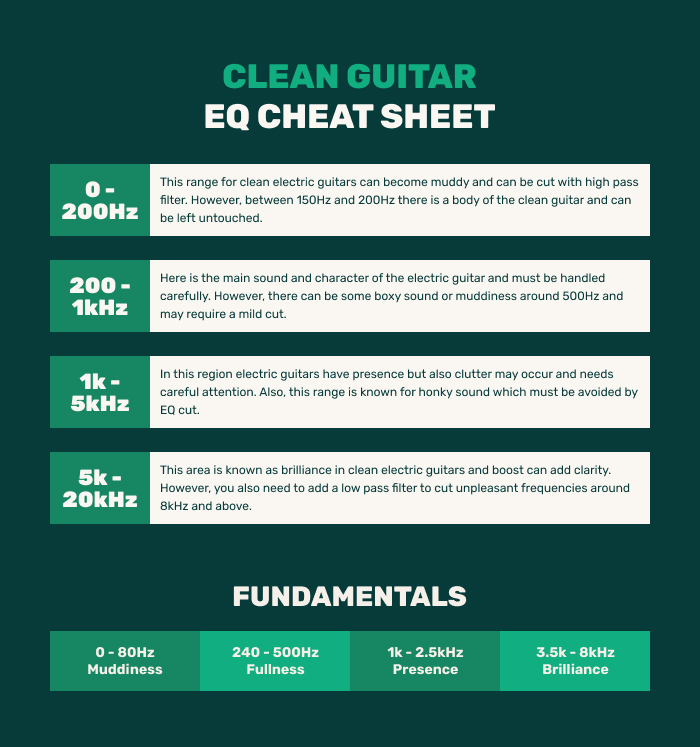
Clean Guitar EQ Cheat Sheet
- 0-200Hz – Low end that mostly competes with the bass. A high-pass, often somewhere around 80-120Hz, cleans it up. 150-200Hz is the body of a clean guitar, so set the filter by ear and stop before the tone thins out.
- 200-1000Hz – The core tone and character when mixing clean electric guitars, so treat it with care. If the guitar sounds boxy or muddy, a small cut around 400-500Hz is the usual fix.
- 1000-5000Hz – Where a guitar gets heard, and where it collides with the vocal. A small boost adds definition. A narrow cut helps if the tone turns honky or harsh.
- 5000-20000Hz – Brilliance. A gentle boost can add sparkle and clarity. If there is fizz, hiss or pick noise above about 8kHz, a gentle low-pass tidies it up.
Free Download: EQ Frequency Chart Poster
Every instrument’s frequency range on one colour-coded chart. Print it, pin it above your monitors, and stop guessing where to cut.
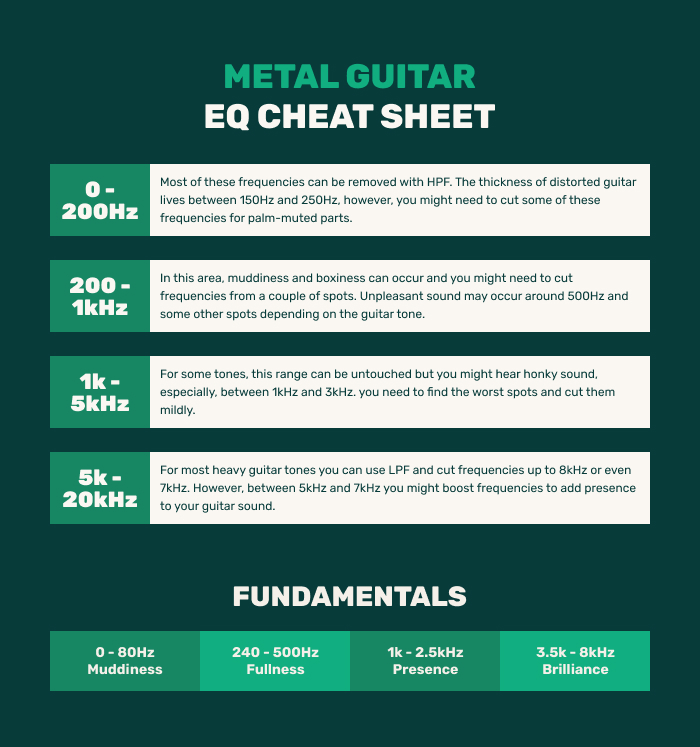
Metal Guitar EQ Cheat Sheet
- 0-200Hz – A high-pass, often around 80-100Hz, keeps the guitars from fighting the bass and kick. The fullness of a distorted guitar sits roughly between 150 and 250Hz, and palm-muted parts can build up too much of it, so check those sections in particular.
- 200-1000Hz – Where distorted guitars get muddy or boxy. Look for build-ups around 400-500Hz and for resonances the amp and cabinet add, and cut those spots rather than the whole range.
- 1000-5000Hz – Aggression and presence. Some tones need nothing here, but a honky or harsh spot between 1 and 3kHz is common when mixing heavy electric guitars. Find it and apply a mild cut.
- 5000-20000Hz – Distortion adds a lot of fizz up here. A low-pass around 7-8kHz is common on heavy tones. Set it by ear and raise it if the guitar goes dull. Below it, a small boost between 5 and 7kHz can add definition.
Conclusion
Start from the charts, then listen with the rest of the band playing before you commit. The bass and kick cover the low end a guitar gives up, and in a song with a vocal, the guitar and the voice have to share the upper mids, so a lot of good guitar EQ is about what you leave room for. Our EQ cheat sheet shows the ranges for everything else in the mix.
Free Download: EQ Frequency Chart Poster
Every instrument’s frequency range on one colour-coded chart. Print it, pin it above your monitors, and stop guessing where to cut.

Lasha is a guitarist with over 18 years of experience who started out in local bands, then taught himself recording in 2010 and began tracking his own demos. He has written about music production since 2016, most recently at ApartmentRecording.com, covering recording and mixing techniques across guitar, bass and drums.