
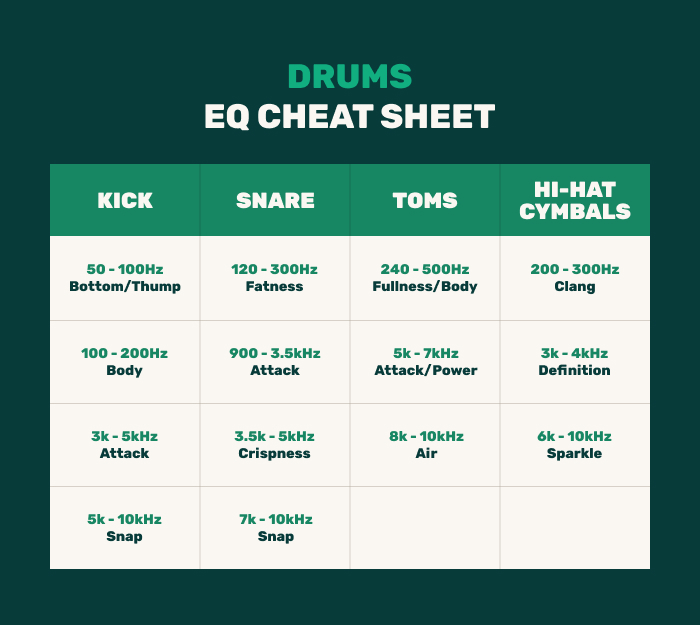
A drum EQ cheat sheet tells you where each part of the kit tends to live, so you know where to start listening. The ranges below cover the kick, snare, toms and cymbals.
Treat them as starting points, not settings. The drum, the tuning, the mics and the genre all move them, so make each decision in the full mix rather than in solo.
Drum Frequencies
The chart gives the short version for the whole kit. The sections under it go drum by drum, and our guide to mixing drums covers balance, compression and reverb.
Kick Drum EQ Cheat Sheet
- 0-40Hz – Sub rumble. Many acoustic kicks have little useful content this low, and a high-pass around 30-40Hz tidies it up. Check first: an 808 or an electronic kick can have its fundamental in this range, and filtering it takes the weight with it.
- 40-100Hz – The bottom and thump. This is where the kick’s weight lives and where it usually meets the bass. Decide which of the two owns the lowest octave and give the other a little room, rather than cutting both.
- 100-200Hz – Body. A little here fills out a thin kick. Too much and it starts to sound boomy.
- 200Hz-2kHz – Where a kick turns boxy, papery or hollow. If it does, sweep a narrow cut through this range; boxiness is often around 300-500Hz, and a knocky or nasal tone sits higher, closer to 1kHz. Plenty of kicks need nothing here, and our guide to EQing a kick drum covers how to find the spot.
- 2-5kHz – The beater attack, which is what lets a kick cut through a dense mix. Boost a little if the kick disappears on small speakers, and leave it alone if it already clicks.
- 5-10kHz – Snap and top-end click. A gentle lift can help a metal or electronic kick. There is usually little kick above that, so a low-pass filter is an option when the kick mic is picking up cymbal bleed.
Free Download: EQ Frequency Chart Poster
Every instrument’s frequency range on one colour-coded chart. Print it, pin it above your monitors, and stop guessing where to cut.
Snare EQ Cheat Sheet
- Below 100Hz – On a close snare mic this is mostly kick bleed and rumble. A high-pass somewhere between 80 and 120Hz is common. Set it by ear, because the higher it goes, the thinner the snare gets.
- 120-300Hz – Fatness and body. A small lift around 150-250Hz can fill out a thin snare.
- 300-600Hz – Boxiness and ring build up here. A narrow cut helps when the snare sounds like a cardboard box, though retuning or a little damping at the source often works better. Our guide to mixing the snare covers the rest of the chain.
- 900Hz-3.5kHz – Attack and crack. A boost of a couple of dB around 2kHz adds bite. Keep the Q moderate and stop before it turns harsh.
- 3.5-5kHz – Crispness. The rattle of the snare wires starts to come through here.
- 5-10kHz – Wire sizzle, snap and air. A gentle shelf adds definition. Depending on placement, a close snare mic can pick up a lot of hi-hat up here too, so if the hat is too loud in it, try a low-pass or a shelf cut above 10kHz.
Toms EQ Cheat Sheet
- Below 80Hz – A high-pass under each tom’s fundamental cleans up rumble. Set it per drum: a floor tom sits well below a rack tom, so one frequency for all of them will thin out the big ones.
- 80-300Hz – The fundamental and the thump. How much you want depends on the size of the tom and how big the fills should feel.
- 300-800Hz – Where toms go boxy or hollow. A cut here, often around 400-600Hz, is the usual fix.
- 3-7kHz – Stick attack. A small lift helps fills read through the mix. Where exactly depends on the tom and the heads, so sweep for it.
- 8kHz and up – Air. Close tom mics also pick up a lot of cymbal up here, and a low-pass or a high shelf cut keeps that bleed down.
Cymbals EQ Cheat Sheet
- Below 200Hz – On a hi-hat or spot cymbal mic, a high-pass up to around 200Hz, sometimes higher, removes kick and snare bleed. Overheads are different: if they carry the picture of the whole kit, a high-pass set that high strips the body of the kick, snare and toms out of it, so go gently there.
- 200-300Hz – Clang. Cut here when the cymbals sound gongy.
- 3-4kHz – Definition, especially the stick on the hi-hat. Cut a little if the cymbals sound harsh.
- 6-10kHz – Sparkle, and also where cymbals turn piercing. A small cut around 8-10kHz takes the edge off without dulling them.
- 10-20kHz – Air. A gentle shelf around 12-15kHz can open the kit up. If there is hiss up there, a shelf cut or a gentle low-pass is enough.
Conclusion
The chart tells you where to start. After that, listen to each drum with the rest of the kit playing before you commit to a move. Small cuts in the right place do more than big boosts, and the kits you mix regularly will teach you their own numbers faster than any general guide. For the rest of the mix, our EQ cheat sheet puts every instrument in one table.
Free Download: EQ Frequency Chart Poster
Every instrument’s frequency range on one colour-coded chart. Print it, pin it above your monitors, and stop guessing where to cut.

Lasha is a guitarist with over 18 years of experience who started out in local bands, then taught himself recording in 2010 and began tracking his own demos. He has written about music production since 2016, most recently at ApartmentRecording.com, covering recording and mixing techniques across guitar, bass and drums.