Music theory is the vocabulary for things you already hear. You know when a chord sounds like home and when it sounds like it wants to go somewhere. You know when a melody lifts and when it lands. Theory gives those moments names, so you can make them happen on purpose instead of hunting for them by accident.
This guide covers the parts of theory a beginner actually uses: the twelve notes, scales, intervals, chords, keys, progressions, rhythm and melody, with a worked example at the end so you can see the chords and the melody working together in one song. Everything here is meant to be played, not just read. Keep a keyboard or a DAW piano roll open and press the notes as you go. Theory that stays on the page doesn’t stick; theory you’ve heard does.
What Music Theory Is (And What It Isn’t)
Much of music theory is a description of what tends to work, written down after the fact: people wrote songs, other people noticed the patterns, and the patterns got names. (Some theory also gives you procedures for writing new music, and we’ll use a few of those too.) That order matters, because it tells you how to use theory: as a map of choices other musicians have made, not a set of laws.
So theory won’t write your music for you, and breaking a “rule” is often the best thing in a song. What it will do is speed you up. Instead of trying every note until one fits, you’ll know which handful are likely to fit and why. Instead of a chord progression that mysteriously works, you’ll know it’s an I, V, vi, IV, and you’ll be able to write another one in a different key in thirty seconds.
One more thing before the content: you don’t need to read sheet music to use any of this. A DAW’s piano roll is a kind of notation, laid out on a grid instead of a staff. We’ll cover the staff briefly so you can find your way around a chord chart or a lead sheet, but every idea here works on a piano roll.
Learn Music Theory by Ear
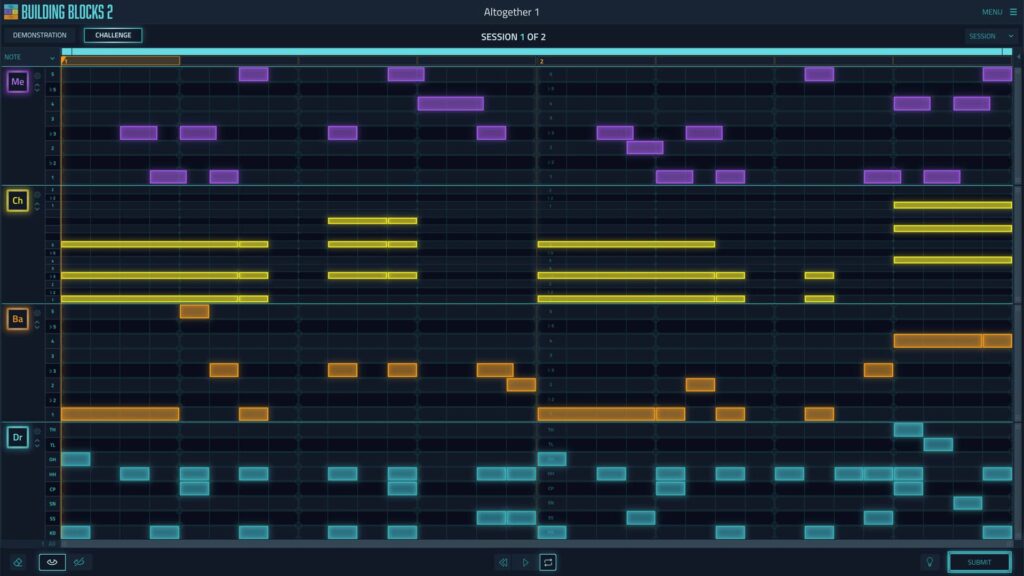
Building Blocks trains your ear to hear chords, melodies and basslines, so whatever you make in your DAW sounds like you meant it. Video-game style.

The Twelve Notes and the Piano Layout
The system your keyboard and your DAW use (equal temperament, if you want the name) has twelve notes, and then they repeat. On a piano, the white keys are the seven letter names, A through G, and the five black keys are the notes in between them. After G comes A again, one octave higher: the same note name, twice the frequency, so it sounds like the same note in a higher register.
The black keys have two names each. The black key between C and D is C sharp (C#) when you think of it as C raised, and D flat (Db) when you think of it as D lowered. Same key, same sound, two names; which one you use depends on the key you’re in, and we’ll get to that. There is no black key between E and F, or between B and C, which is the piece of trivia that trips everyone up at least once.
The smallest distance between two notes in that system is a half step (also called a semitone): from any key to the very next key, black or white. Two half steps make a whole step. Every scale and chord in this guide is just a pattern of half steps and whole steps, which is why it’s worth learning the keyboard layout even if you’ll never play piano. Our guides to every note on the piano そして the black keys go deeper if you want a solid base.
Scales: The Major Scale and Its Minor Cousins
A scale is an ordered set of notes chosen from the twelve. When a song is in a key, one note acts as home (the tonic) and a scale built on it supplies the basic set of notes. Songs borrow notes from outside that set all the time, but it’s where you start. Most pop, rock and electronic songs use seven of the twelve at a time, and the two most common ways to pick those seven are the major scale and the minor scale.
The major scale
The major scale is a pattern of whole (W) and half (H) steps: W W H W W W H. Start on C and follow it and you get C D E F G A B C, all white keys, which is why C major is where everyone starts. Start on G and follow the same pattern and you get G A B C D E F# G. Same shape, different starting note, one black key.
Number the notes of the scale 1 through 7 (these are the scale degrees). Everything that follows, from chords to progressions, is described with those numbers, because the numbers stay the same no matter what key you’re in. Degree 1 is the tonic, the note that feels like home.
The natural minor scale
Play the C major scale’s notes but start and end on A, and you have A natural minor: A B C D E F G A. The pattern is W H W W H W W. Same seven notes and the same key signature as C major, different home note, and it sounds noticeably darker. Every major scale has a relative minor whose natural-minor scale shares its notes, starting on degree 6. That relationship is one of the most useful shortcuts in theory, because every chord in C major is also available in A minor, even though it does a different job there.
The raised seventh
There’s one twist. Play A natural minor and go from G up to A: the pull toward home is gentle, because G is a whole step away. A lot of minor-key music, especially anything with a classical or jazz streak, raises that G to G#, a half step below A, so the arrival lands harder. That raised seventh is called the leading tone, the scale with it in is the harmonic minor, and its main effect is on the chords: the chord on the fifth degree becomes E major (or E7) instead of E minor. Plenty of pop, rock and electronic music stays on the natural minor and its E minor chord and sounds fine; the raised seventh is a choice, not a requirement. A key, then, isn’t one fixed scale: music in A minor can use G or G#, and sometimes F# too.
Minor gets called “the sad scale,” and it’s true often enough to be a useful first impression. But plenty of minor-key songs are aggressive, mysterious or triumphant, and plenty of major-key songs are heartbreaking. The mood comes from the whole arrangement; the scale just tilts it.
The pentatonic scale
Take a major scale and remove degrees 4 and 7. What’s left is the major pentatonic: five notes, and almost nothing you play with them sounds wrong. Do the same trick on the natural minor scale (remove degrees 2 and 6) and you get the minor pentatonic, the scale behind a huge share of rock and blues guitar solos and plenty of vocal melodies. When you’re stuck for a melody, the pentatonic is the safest place to start improvising, and our guide to playing scales on the piano has the fingerings and a practice routine.
Intervals: The Distance Between Two Notes
An interval is the distance between two notes, counted in half steps (strictly, the letter names matter too, but half steps get you started). Intervals are the real unit of music theory: chords are stacks of intervals, melodies are sequences of them, and “happy” versus “sad” is usually one interval changing by a half step.
| Interval | Half steps | Sounds like |
|---|---|---|
| Minor 2nd | 1 | The Jaws theme, the two notes that alternate |
| Major 2nd | 2 | The first two notes of “Frère Jacques” |
| Minor 3rd | 3 | The first two notes of “Greensleeves” |
| Major 3rd | 4 | The first two notes of “When the Saints Go Marching In” |
| Perfect 4th | 5 | “Here Comes the Bride” |
| Tritone | 6 | The Simpsons theme (“The Simp-“), unstable and tense |
| Perfect 5th | 7 | The opening leap of “Twinkle Twinkle” and of the Star Wars main title |
| Octave | 12 | The first two notes of “Over the Rainbow” |
You don’t need to memorize all of these today. Learn four by ear: the オクターブ, the perfect fifth (the sound of a power chord), and the major third そして 短3度. The last two are the switch between a major chord and a minor chord, and being able to hear which one you’re playing is worth more than any amount of reading.
Chords: Stacking Thirds
A 見つける, for our purposes, is three or more notes sounding together. The simplest and most common chord is the triad: three notes that can be stacked in thirds. The easy way to build one inside a key is to take a scale degree, skip one, take the next, skip one, take the next. In C major, starting on C, that’s C E G. Starting on D it’s D F A. The three notes are called the root, the third and the fifth.
The four triad types
| Triad | Built from | Half steps | Example |
|---|---|---|---|
| メジャー | Root + major 3rd + perfect 5th | 4 then 3 | C E G |
| マイナー | Root + minor 3rd + perfect 5th | 3 then 4 | C Eb G |
| ディミニッシュド | Root + minor 3rd + diminished 5th | 3 then 3 | C Eb Gb |
| オーギュメント | Root + major 3rd + augmented 5th | 4 then 4 | C E G# |
Major and minor do most of the work in popular music. Diminished shows up as a passing chord and as the triad built on the seventh degree (vii°) of every major key. Augmented is rare and dramatic. The whole difference between major and minor is the middle note moving by one half step, which is why that major-third-versus-minor-third ear training pays off immediately.
The chords that live in a key
Build a triad on each of the seven degrees of a major scale, using only the scale’s notes, and you get the seven ダイアトニックコード of that key. Theory labels them with Roman numerals, uppercase for major and lowercase for minor, so the pattern is the same in every major key:
| Degree | I | ii | iii | IV | V | vi | vii° |
|---|---|---|---|---|---|---|---|
| Quality | メジャー | マイナー | マイナー | メジャー | メジャー | マイナー | diminished |
| In C major | C | Dm | Em | F | G | Am | Bdim |
| In G major | G | Am | Bm | C | D | Em | F#dim |
This table is the most useful thing in this guide. If a song is in C major, its chords almost certainly come from that row, and if you want to write in C major, those are your first seven choices. Our piano chords chart lays out every one of them for every key, and how to make chords walks through building them from scratch.
Seventh chords
Add one more third on top of a triad and you get a セブンスコード, four notes, richer and more specific. Three types matter for beginners. A 長7度 (Cmaj7: C E G B) is soft and dreamy. A dominant seventh (C7: C E G Bb) is the tense, bluesy one; as the V chord of a key it pulls hard toward home, and in blues it’s used on every chord without resolving anywhere. A 短7度 (Cm7: C Eb G Bb) is the mellow one in R&B and neo-soul. The difference between them is the third and the seventh, and we’ve compared them side by side in C7 vs Cmaj7 vs Cmin7 そして dominant 7 vs maj7 vs m7.
Inversions and voicing
A chord doesn’t have to have its root on the bottom. C E G, E G C and G C E are all a C major chord: root position, first inversion and second inversion, named by which note is in the bass. Choosing how the notes are spread out and ordered is voicing, and moving each note the shortest distance to the next chord is voice leading. Together they’re how you move between chords without your hands (or your MIDI notes) jumping around. Start noticing it: most smooth-sounding progressions are smooth because each note moves by a step or stays put, not because the whole chord shifts.
Keys and Key Signatures
A キー is a home note plus the scale built on it. A song in G major treats G as home and uses the G major scale’s notes, so its chords come from the G major row of the table above. A song in A minor treats A as home and draws on the A minor scales: natural minor, which shares its notes and key signature with C major, plus the raised seventh when the song wants it.
A key signature is the written shorthand for that: the sharps or flats a key uses, printed once at the start of a staff instead of next to every note. C major and A minor have none. G major and E minor have one sharp (F#). F major and D minor have one flat (Bb). Starting from C on the circle of fifths, the diagram every theory book includes, each step clockwise adds a sharp and each step counterclockwise adds a flat.
In a DAW you rarely see a key signature, but you still need to know what key you’re in, because it tells you which chords and notes are the safe ones. Most piano rolls let you set a scale and highlight its notes; do that, and the chords in the table are the ones you can build using only the notes that light up. That’s also the fastest way to learn keys other than C: set the scale to E major, build triads on the highlighted notes, and you’ve just learned E major’s chords by using them. Why you should learn music theory in a DAW makes the longer case for this.
Chord Progressions: Tension and Home
A chord progression is a sequence of chords, and what makes one work is the push and pull between chords that feel settled and chords that feel like they want to move. In a major key, the I chord is home. The V chord is the strongest pull back toward home. The IV chord is a departure that can go either way. The vi chord is the minor cousin of I and often stands in for it. A large share of the pop, rock and electronic progressions you know are some arrangement of those four jobs. In a minor key the same jobs exist with different labels: i is home, iv is the departure, III is the major cousin that stands in for home, and the pull chord is v (natural minor) or V with the raised seventh.
Progressions worth knowing by number
- I, V, vi, IV: the four-chord loop behind hundreds of hits, from the verse of “Let It Be” to “Someone Like You.” In C major: C, G, Am, F.
- vi, IV, I, V: the same four chords starting on the minor one, which is why it reads as more wistful. In C major: Am, F, C, G.
- I、IV、V: the three-chord skeleton of blues, folk, punk and early rock. In C: C, F, G. The 12-bar blues is a fixed twelve-bar pattern built from these same three chords, usually played as dominant sevenths.
- ii, V, I: the jazz cadence, and the smoothest way to arrive home. In C: Dm, G, C (usually as Dm7, G7, Cmaj7).
- i, VI, III, VII in minor: the minor-key equivalent of the four-chord loop, with the numerals counted from the minor scale (VI is the chord on the sixth degree of A minor, so F major). In A minor: Am, F, C, G.
Notice that the last one uses the same chords as the first. Whether a loop of Am, F, C and G is in A minor or C major depends on which chord the song treats as home. Where the melody rests, where the loop starts and ends, and what the bass leans on are the clues. That ambiguity is a feature; a lot of emotional pop lives in it. Our guides to nostalgic chord progressions そして the sus4 chord take these loops further.
Cadences: how a phrase ends
A cadence is the chord move that closes a phrase. V to I (V to i in minor) is the authentic cadence, the most final-sounding ending in music. IV to I (iv to i in minor) is the plagal cadence, the “amen” at the end of a hymn, softer. V to vi (V to VI in a minor key) is the deceptive cadence: your ear expects home and gets the substitute instead, which is a simple and reliable way to keep a section going when the listener thought it was over.
Rhythm, Meter and Reading the Basics
Everything so far has been about pitch. Rhythm is the other half, and beginners skip it far more often than they skip harmony, which is a mistake: a plain chord progression with a great rhythm beats a clever one with a dull rhythm every time.
Beats, bars and time signatures
各コードの後の beat is the steady pulse you tap your foot to, and tempo is how fast it goes, in beats per minute (BPM). Beats group into bars (also called measures), and the time signature says how. 4/4 means four beats per bar, with the quarter note getting one beat; it covers most pop, rock, hip hop and electronic music. 3/4 is three beats per bar, the waltz feel. 6/8 is two beats per bar, each divided into three equal eighth-note subdivisions, the swaying feel of many ballads and folk songs.
Note values
A whole note lasts a full bar of 4/4. A half note is half of that, a quarter note is one beat, an eighth note is half a beat and a sixteenth is a quarter of a beat. A dot after a note adds half its length again. Rests are silences of the same lengths. On a piano roll, these are just the grid divisions: the quarter-note grid, the eighth-note grid, the sixteenth-note grid.
Syncopation is putting an accent where the meter doesn’t expect one: a hit on the “and” between beats with nothing on the beat, or a note tied across the bar line. It’s most of what makes a groove feel alive. A separate tool is timing feel, nudging a few hits slightly ahead of or behind the grid the DAW snapped them to. If your drums or chords feel stiff, the fix is usually one of those two, not more notes.
The staff, for when you meet one
Written music sits on a staff of five lines. A clef at the start tells you which notes the lines mean: the treble clef for higher parts (right hand, melodies, most instruments) and the bass clef for lower ones. Middle C sits just below the treble staff and just above the bass staff, which is how the two connect. You won’t need to sight-read to produce music. Knowing this much gets you oriented on a lead sheet; reading one fluently takes more practice. The chord symbols written above the staff (C, Am7, G/B) are a separate, smaller skill, and this guide has already given you most of it.
Melody: What Makes a Line Sing
A melody is a sequence of single notes with a rhythm, and the theory of melody is mostly about how it relates to the chords underneath. The notes of the current chord (its root, third and fifth, plus the seventh if it has one) are chord tones; they sound stable. The other scale notes are non-chord tones; they sound like they’re on their way somewhere. The most common kind, the passing tone, walks from one chord tone to another by step, continuing in the same direction. As a starting habit, put chord tones on the strong beats and use passing tones to get between them; once that feels natural, an accented non-chord tone is one of the best ways to add tension.
Three other things separate a melody people remember from one they don’t. Contour: the shape of the line. Rising toward one peak and falling away is the commonest shape, but whatever the shape, it should feel deliberate rather than wandering. Repetition with variation: a short idea (a motif) stated, then repeated with one thing changed, rather than a stream of new material. And range: most singable melodies stay inside about an octave and a half. We’ve written a full guide to how to write melodies、そして MIDI Recipes break down real melodies, basslines and chord progressions from well-known tracks so you can see these ideas in context.
Analyzing a Song You Love
Analysis sounds academic, but it’s just listening with the vocabulary above. Here’s the routine, and it takes about ten minutes per song once you’ve done it a few times.
- Find the key. Play along on a keyboard until you find the note that sounds like home. The bass note under the chord where the chorus finally settles is a good first guess; cross-check it against where the melody comes to rest. The chord built on that note tells you major or minor.
- Work out the chords and write them as Roman numerals in that key. You’ll be surprised how often it’s the table above with nothing outside it.
- Map the sections: intro, verse, pre-chorus, chorus, bridge, and how many bars each one lasts. Note where the progression changes and where it doesn’t.
- Look at the melody against the chords. Which notes land on the downbeats? Usually chord tones, and the exceptions are worth a second listen. Where does the melody peak? Often in the chorus.
Take “Let It Be.” The verse runs C, G, Am, F, then C, G, F, C: in C major that’s I, V, vi, IV and then I, V, IV, I, the four-chord loop from earlier followed by a plain landing on home. The chorus leans on Am, G, F, C, so vi, V, IV, I, the same chords reshuffled. The melody sits on chord tones at nearly every bar line and peaks on the word “be.” Almost nothing in the verse or chorus steps outside the C major table (the descending run in the outro borrows a Bb), and it’s one of the most loved songs ever written. That’s the lesson of analysis: the tools are simple; the craft is in how they’re used.
Putting It to Work: From Theory to Writing
Here’s a first project that uses everything above, in one sitting.
- Pick a key. C major, or A minor on the natural-minor notes, if you want all white keys.
- Loop a four-chord progression from the list, two bars per chord, voiced so that each note moves as little as possible from one chord to the next.
- Write an eight-bar melody over it using the pentatonic scale, chord tones on the downbeats, one clear peak.
- Give the drums one syncopated hit: a snare on the ‘and’ where the ear expected the beat.
- Then step outside the default on purpose: put a non-chord tone on a downbeat, or end a phrase on the vi chord instead of the I. Listen to what it does.
That last step is the point. Theory tells you the default, which is exactly what you need to know in order to surprise someone. Once this project feels easy, our guide to music theory for composition picks up from here with modulation, borrowed chords, counterpoint and form.
If you’d rather learn all of this by ear, in a piano roll, with a graded path instead of a reading list, that’s what we built Building Blocks for. It teaches the same material in this guide by having you write it, one piece at a time.
Four Beginner Mistakes To Skip
- Learning rules without sounds. If you can’t hear the difference between a major and a minor third, knowing the half-step count does nothing for you. Play every example.
- Treating rhythm as an afterthought. Harmony gets the attention; rhythm gets the listener.
- Trying to memorize every scale and mode. Major, natural minor and the two pentatonics cover the vast majority of music you’ll write for a long time. Add others when a song asks for them.
- Assuming minor means sad and major means happy. It’s a tilt, not a law. Tempo, rhythm, lyrics and arrangement decide the mood; the scale just leans.
Learn Music Theory by Ear
Building Blocks trains your ear to hear chords, melodies and basslines, so whatever you make in your DAW sounds like you meant it. Video-game style.

Frequently Asked Questions
Do I need to read sheet music to make music?
No. Every idea in this guide works on a piano roll, and many producers never sight-read. Learning the basics of the staff is still worth an afternoon because it gets you oriented on chord charts and lead sheets, which are the fastest way to learn other people’s songs.
How long does it take to learn music theory?
The basics here, the notes, major and minor scales, triads, the diatonic chord table and the common progressions, take most people a few weeks of short daily sessions to get comfortable with, and a few months to use without thinking. Hearing them takes longer than reading them, so start the ear training on day one.
Is music theory different for piano, guitar and DAWs?
The theory is identical; only the layout changes. The piano shows it most clearly, which is why theory is taught on it, and a DAW piano roll is a piano turned on its side. Guitar hides the pattern a little because the same note appears in several places on the neck, but the intervals and chords are the same.
Where should I start?
Learn the keyboard layout, then the C major scale, then the seven chords of C major, then loop I, V, vi, IV and write a pentatonic melody over it. That single week of work gives you a base most of this guide builds on.
結論
Twelve notes, two main scales, four triad types, seven chords per key, a handful of progressions, and a rhythm that moves. That’s the beginner’s kit, and it’s enough to write a great many of the songs on the radio. The next step isn’t more reading; it’s opening a piano roll and using each idea until it’s yours.